Risk Management
Mar 19, 2026
Fraud Prevalence in B2B Trade Credit
Michael Carnie
Sales Operations
Explore the most pressing fraud challenges in the B2B landscape and how to defend against them.
Trust is the foundation of trade credit. Suppliers often deliver products before receiving payment, relying on established processes and trust in customers. Although this flexibility supports growth, it also increases the risk of fraud.
B2B fraud is on the rise, according to industry studies. According to the National Association of Credit Management (NACM), over 60% of B2B businesses have encountered attempted payment or credit fraud, and many report an increase in fraudulent applications from year to year [1].
This article shares our insights as a leading provider of credit risk management systems on how fraud appears in B2B trade credit, why it’s becoming more common, and what companies can do to reduce risk without slowing down legitimate customers.
What Does B2B Trade Credit Fraud Entail?
B2B trade credit fraud involves a business distorting its identity, authority, or financial condition to obtain goods on credit with no intention of paying.
Fraudsters might:
Use legitimate business names with fake email addresses or phone numbers.
Pretend to be finance managers or authorized buyers.
Make fictitious shell corporations.
Submit forged or recycled trade references.
Why Fraud Is Increasing
According to our clients, there are three primary reasons why fraud attempts have increased in frequency:
AI Prevalence
Modern fraud schemes often combine phishing techniques with deep fakes and AI-generated business data to create applications that appear legitimate at first glance.
Pressure from the economy
According to NACM, almost 1 in 4 businesses report a higher risk of misrepresentation from clients who are having cash flow issues during times of higher interest rates and tighter credit markets [2].
Data availability
Social media profiles and publicly available business records facilitate the creation of convincing false identities. With only slight modifications, fraudsters can repurpose authentic company information to make applications seem genuine.
Fraud is no longer restricted to applications that are blatantly suspicious; many attempts now evade simple surface-level checks.
Typical Fraud Trends
To find out where B2B trade credit fraud is most common, use the categories below.
When candidates pretend to be someone they're not:
Using a real company name with a personal email address.
Submitting valid business registration numbers with fake contact details.
Posing as a worker without the ability to sign documents.
Advanced fraud can include fabricating entities and data synthesis risks (data forgery).
According to DepositFix, about 30–40% of fraudulent applications that are manually reviewed involve identity-related fraud [3].
There's also financial deception.
When candidates fabricate or overstate their capacity to pay:
Inflated earnings or staff numbers
Bank references that are out-of-date or fake
References to related or dormant businesses
Even in cases where financial misrepresentation is not considered criminal fraud, TransUnion’s Global Fraud Report reveals that it is present in more than half of failed B2B credit accounts [4].
Account Takeover.
When the identity of a current client is compromised:
Without adequate verification, billing contacts are altered
Shipping addresses are rerouted
Orders are made using credit limits that have already been authorized
Because account takeover takes advantage of trusted accounts, it is particularly expensive. Losses from account takeovers are two to three times greater than losses from first-time fraudulent applicants in certain industries.
The Effect on Business
Trade credit fraud is not limited to unpaid invoices.
Experience of companies:
Lost service value or inventory.
Higher write-offs and reserve requirements.
Higher legal and collection expenses.
Credit limits and risk metrics are distorted.
According to Atradius, fraud or misrepresentation, as opposed to typical business failure, accounts for 5–10% of bad debt [5]. Over time, unchecked fraud forces credit teams to become more restrictive, which can slow revenue growth and strain customer relationships.
How to Reduce Fraud Without Increasing Difficulties
Fraud prevention is the most effective when built directly into credit onboarding rather than a separate review process. Integrating verification and risk checks into regular workflow allows businesses to minimize the exposure without creating roadblocks for applicants.
Integrated fraud prevention checklist
Centralize fraud signals in credit workflow. Combining third-party data, internal history and exception flags will help combine fraud controls alongside credit decisions
Monitor account changes after approval. Tracking updates on the account will help to detect someone draining their account.
Apply risk rules in real time. Have verification steps when applications deviate from the normal patterns.
Standardize data for all applications. Using a structured field instead of free-text allows proper consistency and automated comparisons
To meet the requirements consistently, fraud prevention can be incorporated into a digital onboarding process. This allows businesses to standardize the data collection, automate verification warnings, and apply fraud controls and steps in real time without adding any stress to actual customers.
PDF vs. NetNow’s Platform
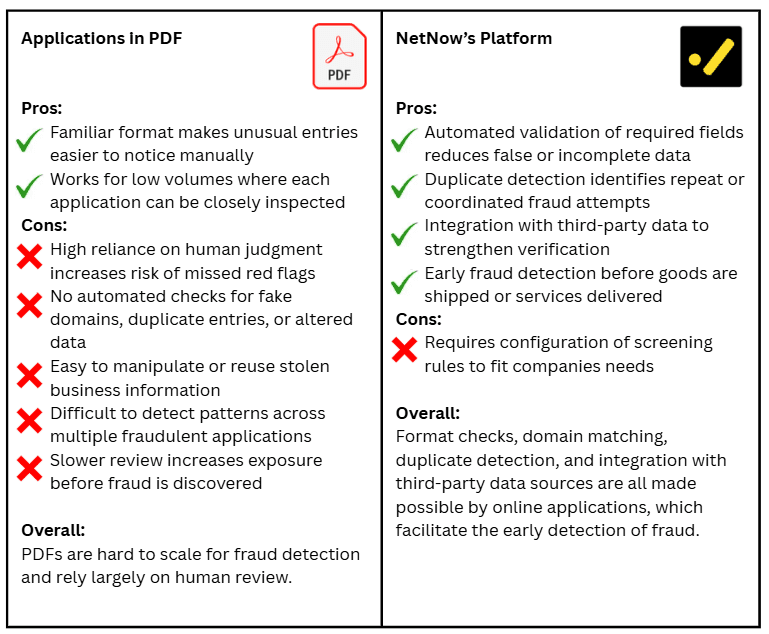
Fraud risk is influenced by how applications are collected.
Conclusion
B2B trade credit fraud is now a quantifiable operational risk rather than an edge case. Businesses are better positioned to expand safely if they approach credit onboarding as both a sales and a risk function.
NetNow can assist you if you're prepared to improve your trade credit procedure. To find out how automated verification and digital credit applications lower fraud and speed up approval with real-time alerts, schedule a demo.
[1] https://bcm.nacm.org/rising-fraud-risks-in-b2b-trade/
[2] https://bcm.nacm.org/fraudulent-credit-applications-are-on-the-rise/
[3] https://www.depositfix.com/blog/b2b-payments-statistics
[4] https://newsroom.transunion.com/h2-2025-global-fraud-report/
[5] https://atradius.ca/en_CA/Knowledge-and-research/reports/b2b-payment-practices-trends-usmca-2025
Read More
Find articles relevant to your interests